














What wonders lie beneath Türkiye’s surface
Türkiye’s history is long, and for travelers, its variety offers more than most destinations. Stories of the Trojan War, Neolithic civilizations, and historic trade routes have emerged from excavations, revealing the forgotten truths of ancient life.
But what many don’t realize is, sometimes, the best discoveries are still just beneath the surface.

İSTANBUL: REIMAGINED SPACES
Every year, millions of travelers navigate the bustling streets of İstanbul in search of culture, creativity, and adventure. Beneath their feet, unknown to most, is a vast network of several hundred ancient cisterns. Once used to store water for the above world, they now offer visitors a chance to explore a quieter side of the city – in the tranquil chambers that continue to echo the past.


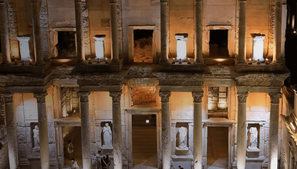
The Basilica Cistern is the largest of these hidden spaces which, at 143 meters long and 65 meters wide, is akin to the size of a cathedral.
Built by the Eastern Romans in the 6th century to service the Great Palace of Constantinople and surrounding buildings, it once stored up to 80,000 cu meters of water from the Belgrad Forest. Now, only shallow pools remain, inhabited by schools of carp that swim among visitors.
40 years since it was renovated and opened to the public, the Basilica Cistern is one of İstanbul’s most unassuming, yet remarkable landmarks.
Walk the wooden platforms, admiring the hundreds of illuminated columns and two enormous Medusa heads, upturned supposedly to remove her petrifying powers.
The Şerefiye (or Theodosius) Cistern is perhaps the most surprising of its kind in İstanbul.
Likely falling out of use as a primary water source after the Ottoman conquest, it has regained prominence in recent years following its restoration and reopening as a public museum.
Today, the space delights visitors with 360° wall projections that bring history, art, and technology together under one roof.
As digital motifs are cast onto the structures of the Şerefiye Cistern, visitors can learn about the evolution of İstanbul as a “city of water”, marveling as vaulted ceilings and marble columns take on a new dimension.
CAPPADOCIA: UNDERGROUND CITIES
İstanbul isn’t the only region of Türkiye with concealed treasures. Cappadocia in Central Anatolia – famed for its lunar landscape and “fairy chimneys” – is home to a network of subterranean tunnels that were carved into the soft, volcanic rock up to 4,000 years ago. Believed to have provided refuge during invasions, these multi-level spaces would hide tens of thousands of people.


Derinkuyu is not just the largest discovered underground city in Türkiye, but also one of the largest and deepest in the world.
At a depth of 85 meters, its intricate tunneling system reveals everything a productive settlement needed: living spaces, chapels, storage rooms, and stables. While many of these rooms are open to the public, only a small portion of Derinkuyu can currently be visited.
The underground city of Kaymaklı is just as impressive as neighboring Derinkuyu. Passageways are spread across eight floors, with four accessible to visitors.
As you navigate the maze-like “streets”, be sure to take in the walls adorned with ancient frescoes.
Depicting scenes from everyday life and religious scenarios, these artworks offer valuable insight into the lives of people who once lived here.
Summer visitors to Derinkuyu and Kaymaklı should consider venturing below the surface around lunchtime, when you can escape the heat of the midday sun.
As their tunnels were purposefully designed to confuse intruders, it’s best to engage a local guide, who can direct you to notable landmarks and tell stories of their fascinating history.
From İstanbul’s ancient cisterns to Cappadocia’s hidden cities, Türkiye’s underground spaces are undeniable feats of engineering. Their architecture alone is enough to captivate travelers but it’s their promise of uncovering some of the country’s best-kept secrets that will keep them coming back time and again.

BEST TIME TO GO Apr-June

Average TEMP 21ºC

AIRPORT CODE IST / NAV

TIMEZONE GMT+3

Currency Turkish Lira (₺)
DISCOVER MORE ABOUT TÜRKİYE


Discover a different Türkiye